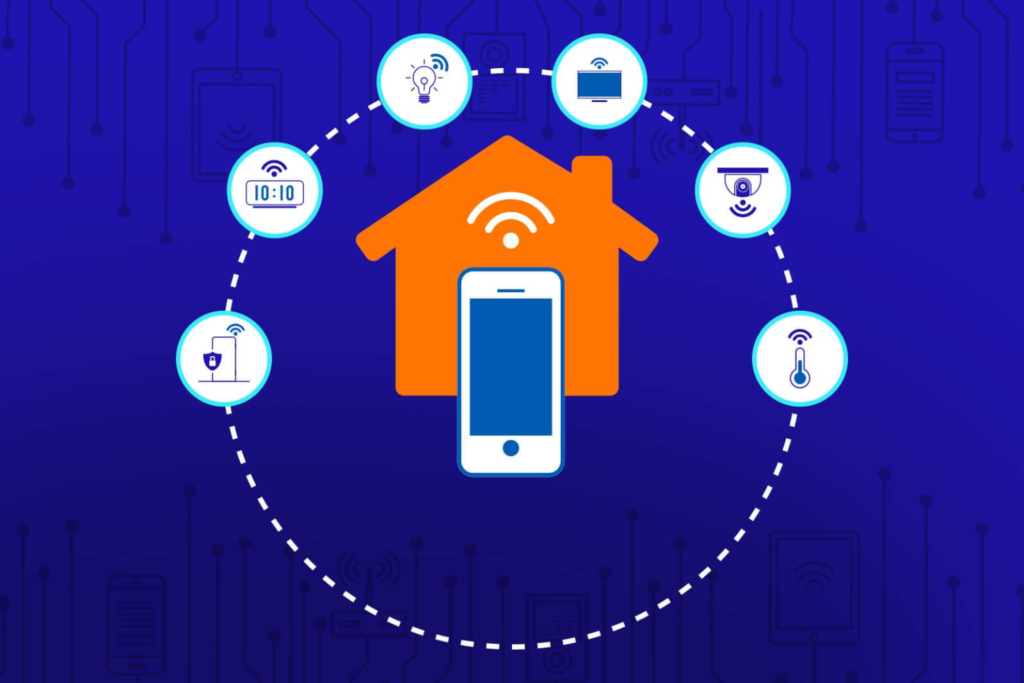
Imagine pulling into your driveway after a long day at work. As you approach, the porch light flickers on, the front door unlocks automatically, and your favorite “winding down” playlist begins to hum through the living room speakers. Inside, the thermostat has already adjusted to your preferred 22°C.
This isn’t a scene from a sci-fi movie; it is the daily reality of a Smart Home. But what exactly makes a home “smart,” and how does the Internet of Things (IoT) make it all work? Let’s break it down in simple terms.
The “Brain” and the “Nerves”: How IoT Works
At its simplest, IoT (Internet of Things) refers to everyday objects—like light switches, fridges, or locks—that are connected to the internet. This connectivity allows them to “talk” to each other and to you.
Think of a traditional home like a collection of independent islands: your toaster doesn’t know your coffee maker exists. In an IoT-enabled Smart Home, these islands are connected by bridges.
- The Sensors (The Eyes and Ears): These devices collect data. A motion sensor “sees” you enter a room; a smart thermostat “feels” the sun warming up the kitchen.
- The Gateway (The Brain): Most smart homes use a central hub or gateway—like the Legrand Smart Gateway—to coordinate all these signals. It takes the data from the sensors and decides what to do next.
- The Actuators (The Hands): These are the devices that actually do something, like dimming a light or closing the motorized blinds.
Why Should You Care? Beyond the “Cool” Factor
While voice-controlling your lights is fun, the true value of a smart home lies in three core areas:
1. Energy Efficiency (and Lower Bills)
A smart home is a sustainable home. Instead of leaving the AC running all day, an IoT thermostat learns your schedule and only cools the house when you’re actually there. Legrand’s smart power outlets can even monitor the energy consumption of individual appliances, helping you spot “energy vampires” that are driving up your monthly costs.
2. Enhanced Security
IoT security goes far beyond a standard alarm. Smart doorbells allow you to see and speak to couriers from your smartphone while you’re at the office. If a leak sensor detects water in the basement, you get an instant notification on your phone before it becomes a flood.
3. True Convenience
Automation means your home works for you. With “Scenes,” you can trigger multiple actions with one tap. A “Goodnight” scene could simultaneously lock the doors, turn off all the lights, and lower the heat—saving you a final walk around the house in the dark.
Starting Your Journey: The “Stage-by-Stage” Approach
Many people assume that building a smart home requires ripping out walls or spending thousands of dollars upfront. In reality, it is much simpler. Modern systems, such as Legrand’s Arteor with Netatmo, are designed to be modular.
You can start small—perhaps with a single Starter Kit that includes a gateway and a few smart switches. Because these devices often use Zigbee wireless technology, they create a “mesh network” that is robust and doesn’t require complex new wiring. Once you’re comfortable, you can add smart dimmers, curtain controllers, or video door entries at your own pace.
The Human Side of Tech
At the end of the day, a smart home shouldn’t feel like living in a computer. It should feel like a more intuitive version of your own home. The best technology is the kind that fades into the background, making your life safer, easier, and more comfortable without you having to think about it.
Whether you want to save the planet, save some money, or just save yourself the hassle of getting out of bed to turn off the kitchen light, IoT is the tool that makes it possible.